Ògún: The Divinity of Technology
Joan Ayebola
Author
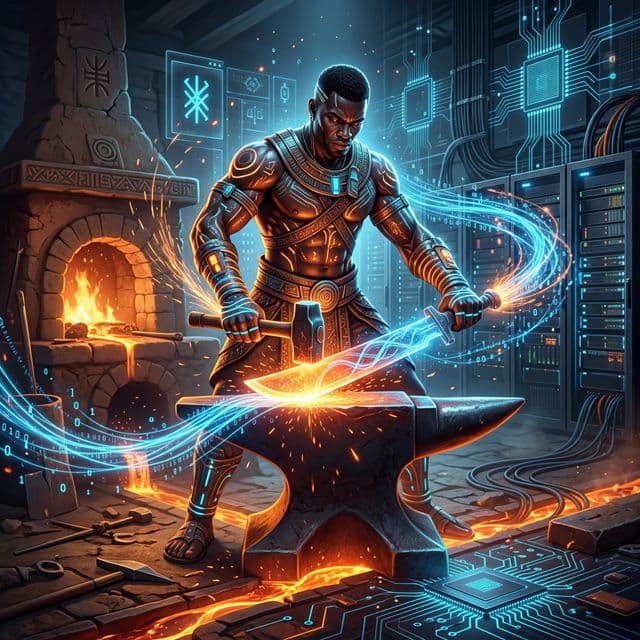
In most popular descriptions of the Yorùbá pantheon, Ògún is reduced to a one-dimensional figure: the angry god of war, draped in palm fronds, wielding a bloody machete. This "warrior-only" lens is a colonial leftover that misses the actual sophisticated philosophy of the Òrìṣà.
In the Odù Ifá, Ògún is titled Oṣìn Imọlẹ̀, the Chief among the Divinities. He holds this rank not because he is the most violent, but because he is the most essential. Ògún is the consciousness of Innovation. He is the pioneer who clears the path, the engineer who builds the infrastructure, and the master of the transformative power of Technology.
The Architect of Civilization
The primary story of Ògún centers on the descent of the Òrìṣà from the spiritual realm to the earth. The divinities found themselves blocked by a "forest of mystery"— a dense, impenetrable barrier that no one could pass. The other deities tried to use their specific powers to break through, but they all failed.
It was Ògún who stepped forward. Using a secret he had mastered (the alchemy of iron), he fashioned a tool that could cut through the impossible. He cleared the path that allowed civilization to begin.
"Viewing Ogun solely as a violent 'god of war' or a primitive deity of destruction."
This isn't just a myth about a forest; it is a metaphor for the human condition. Technology is the 'Clear Path.' Whether it is a stone tool, a steam engine, or a line of code, technology is the tool we use to overcome the 'impenetrable' limitations of nature. Ògún is the spirit of the breakthrough.
The Alchemy of Iron: From Earth to Tool
Ògún is the patron of the Alágbede (the Blacksmith). In ancient Yorùbá society, the blacksmith’s forge was a sacred laboratory. The smith took raw earth (ore) and, through the application of intense heat and specific ritual knowledge, transformed it into something entirely new: Iron (Ìrin).
This is the "Science of Ògún." It is the understanding that the world can be reshaped. Ògún represents the seven stages of this transformation, from the raw, unrefined energy of the earth to the highly polished, functional tool.
He is the scalpel that saves a life in surgery. He is the plow that turns the soil to feed a nation. He is the bridge that connects two divided peoples. While the "weapon" exists, it is only one small application of his vast technological Aṣẹ.
The Ethics of the "Bitter Edge"
Because Ògún’s tools are so powerful, they carry a heavy ethical burden. This is why people in Yorùbá culture traditionally swear oaths on iron.
Iron does not lie. If a builder miscalculates the strength of an iron beam, the building falls. If a programmer writes faulty logic, the system crashes. Ògún is the divinity of Absolute Truth and Integrity. He demands that the "math" of our lives matches the "math" of the universe.
To follow Ògún is to accept the "Bitter Edge" (the realization that every innovation comes with a responsibility). You cannot build a tool without considering how it will be used. Ògún represents the high-stakes pressure of being a creator.
Ògún in the Digital Age
Many people think the Òrìṣà are "ancient" and don't belong in the modern world. This is a misunderstanding of what an Òrìṣà is. An Òrìṣà is a principle of nature.
Ògún is not "the machete." Ògún is the Conductor. In the 1800s, he was the railroad. In the 1900s, he was the internal combustion engine. Today, Ògún is the silicon chip, the fiber-optic cable, and the complex algorithms of AI.
Any time a human being uses their consciousness to create a tool that expands our reach, they are working in the laboratory of Ògún. He is the patron saint of the coder, the data scientist, the mechanical engineer, and the surgeon.
Conclusion
Ògún is the reminder that progress is a spiritual act. We were not meant to live in a state of stagnation; we were meant to clear the path. By reclaiming Ògún as the Divinity of Technology, we stop viewing our tools as "soulless" and start viewing our work as a sacred contribution to the evolution of the world.
To be a master of your craft is to be a child of Ògún.