Olókun: The Genderless Deity of the Deep
Joan Ayebola
Author
Humans have a restless need to categorize. We want our deities to fit into the same neat boxes we use for ourselves: Mother or Father, King or Queen, Husband or Wife. We take the vastness of the divine and try to force it into a human suit.
But Olókun refuses the suit.
As the ruler of the deepest parts of the ocean, the "Abyss" where light cannot reach and human structures dissolve, Olókun represents a state of being that precedes and transcends the gender binary. In some regions of West Africa, Olókun is addressed as a man; in others, as a woman. This isn’t a historical "disagreement." It is a technical description of a deity that exists beyond the "either/or."
The Science of the Deep
To understand Olókun, you have to understand the geography of the ocean floor. In the abyss, the rules of the surface don't apply. There is no sunlight to dictate the rhythm of the day, and the pressure is high enough to crush anything built with a shallow ego.
In Yorùbá philosophy, Olókun is the Olowo Okun, the Owner of Secrets. Gender, at its core, is a surface-level social construct used to organize human interaction. But in the deep, there is only raw, unmanifested potential. Olókun is the "Neutral" power. Unlike Ṣàngó (who is Heat/Action) or Ọ̀ṣun (who is Cool/Diplomacy), Olókun is Static Power. It is the weight of the water itself. It doesn't need to "act" to be powerful; it simply is.
Olókun vs. Olósa: Surface vs. Depth
We often confuse the "Beach" with the "Ocean." In Ìṣẹ̀ṣe, we distinguish between Olósa (the deity of the lagoons and the shore) and Olókun (the deity of the limitless deep).
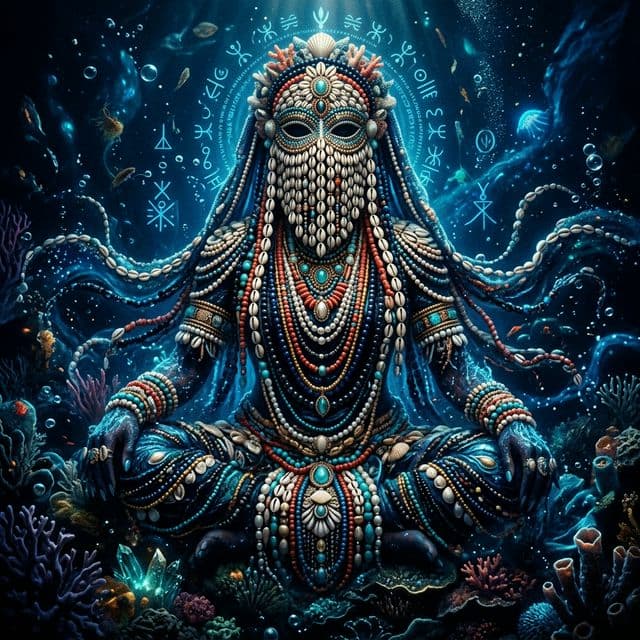
The closer you are to the shore, the more "human" the energies become. Olósa and the Òrìṣà of the rivers often take on clear gender roles because they interact directly with human civilization. But the further you travel into the Atlantic, the more those roles evaporate. Olókun is often depicted wearing a beaded veil or a mask. This isn't just for decoration; it signifies that the true face of the Divine is beyond human definitions of identity. When you look at Olókun, you aren't supposed to see a "woman" or a "man", you are supposed to see the Infinite.
Wealth from the Unknown
There is a reason why the "Genderless" deity is also the deity of infinite wealth (Ajé). In the ancient mind, true wealth didn't come from what was common; it came from the "Unknown." It was the cowries, the coral, and the treasures buried in the silt of the deep ocean.
The logic is simple: To access the wealth of Olókun, you have to be willing to let go of your rigid "ego identity." Most people are poor because they are trapped in who they think they are. Olókun represents the vastness of what you could be if you stopped clinging to labels. Wealth flows to those who can navigate the fluid, the undefined, and the hidden.
Reclaiming Fluidity
Colonialism didn't just bring new religions to Africa; it brought a strict, Victorian gender binary. It taught us to be ashamed of anything "in-between" and to fear the parts of our heritage that didn't fit into a patriarchal box.
But our ancestors were comfortable with the "In-between." They recognized that the most powerful forces in the universe, the ones that govern the tides and the depths of the earth don't fit into neat little categories. Olókun is the patron of the misunderstood, the masked, and the fluid.
Conclusion
Embracing Olókun is an exercise in spiritual expansion. It is a reminder that while gender might help us navigate the "shore" of human society, it cannot follow us into the "abyss" of true consciousness. To sit with Olókun is to sit with the parts of yourself that don't have a label. It is the power of the undefined, and it is where the real treasure is buried.
Reflect & Connect
What parts of your identity have you "veiled" because they don't fit into a standard box? How would your life change if you viewed your "undefined" traits as a source of wealth rather than a source of confusion?