The Power of Àjẹ́: The Mothers and the Foundation of Existence
Joan Ayebola
Author
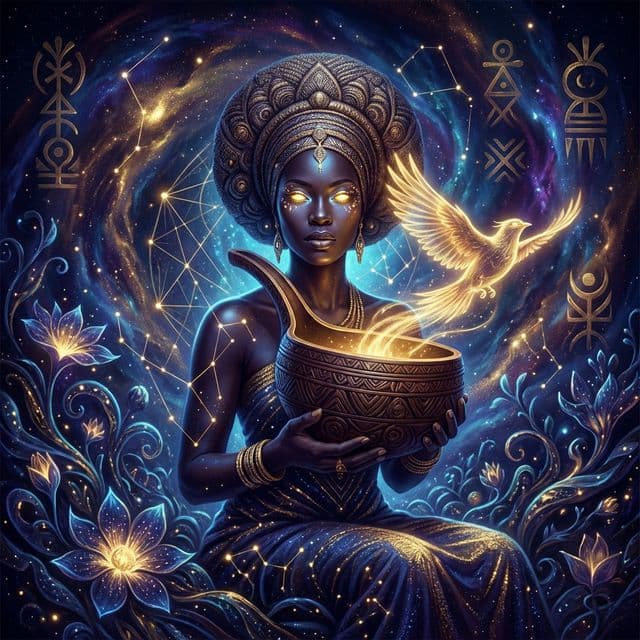
Àlàáfíà. This article is perhaps the most critical for reclaiming the intellectual and spiritual sovereignty of Ìṣẹ̀ṣe. We are moving beyond the fear-based narratives of the colonial era and returning to the Odù Ifá to understand the foundational power of the universe: the feminine.
The Power of Àjẹ́: The Mothers and the Foundation of Existence
In the study of Yorùbá philosophy, there is no word more misunderstood, more mistranslated, or more unfairly maligned than Àjẹ́.
When 19th-century colonial recorders encountered the autonomous spiritual authority of Yorùbá women, they lacked the cultural framework to understand it. They saw women who held the keys to biological life, justice, and the "inner bird" of consciousness, and they reacted with the only label their own history provided: "Witch."
But in Ìṣẹ̀ṣe, an Àjẹ́ is not a villain in a folklore tale. The Àjẹ́ are the Custodians of the Earth, the "Owners of the World," and the essential spiritual force known as Àwọn Ìyá Mi (Our Mothers).
"That the Àjẹ́ are 'evil hags' who plot in the shadows to cause misfortune."
The term 'witch' carries Western baggage. In the indigenous Yorùbá context, Àjẹ́ is a title of spiritual seniority. It refers to those who have mastered the ability to transcend the physical body to interact with the laws of nature. It is a neutral, protective, and administrative power that maintains cosmic equilibrium.
The Lesson of Òṣé Tura: The Seventeenth Òrìṣà
To understand why the world cannot function without the Mothers, we must look at the Odù Ifá of Òṣé Tura. This sacred text contains the "blueprint" for how power must be shared to be effective.
The narrative tells of a time when the sixteen male Òrìṣà descended from the spiritual realm to organize the Earth. They were powerful, wise, and diligent. They built cities and cleared paths, but despite their efforts, nothing flourished. The rain refused to fall, the crops withered, and human society remained in a state of stagnant chaos.
Confused, they returned to Olódùmarè (The Source) to ask why their work was failing. The answer revealed a fundamental cosmic law: they had intentionally ignored the seventeenth Òrìṣà — Ọ̀ṣun, the leader of the Council of the Mothers. They had assumed that their "outer" masculine strength was sufficient, neglecting the "inner" feminine Aṣẹ that sanctions all life.
The Divine Blockage: Èṣù and the Mothers
It is here that we see the partnership between Ọ̀ṣun and Èṣù. Because the Òrìṣà had violated the principle of balance by excluding the leader of the Àjẹ́, Èṣù, acting as the divine enforcer of character (Ìwà) and the protector of the Mothers' rights, refused to carry their prayers or sacrifices to the heavens. The "Messenger" went on strike because the "Owners of the World" had been disrespected.
Only when the Òrìṣà returned to Earth and pleaded for Ọ̀ṣun's participation, humbling themselves to integrate the feminine energy into their council, did the blockage clear. Through this reconciliation, the energy of Èṣù Òṣé Tura was born: the specific manifestation of the Messenger that exists only because the masculine and feminine decided to work in harmony.
The Bird in the Calabash: The Symbolism of Authority
In Yorùbá iconography, the power of the Mothers is often represented by a bird. You will see this bird perched atop the iron staffs of herbalists (Osanyin) or crowning the elaborate Gèlèdé masks.
The bird represents the "astral" consciousness. It signifies that the Àjẹ́ have the vision to see what is hidden and the wings to travel between the physical and spiritual planes. This power is often described as being kept in an Igbá (a closed calabash). This secrecy is not about "darkness"; it is about the sanctity of the womb and the privacy of the soul. In Ìṣẹ̀ṣe, the most potent powers are always those that are "cool," "contained," and "hidden."
Gender Fluidity: Power Beyond the Binary
Because the Àjẹ́ represent the primal force of existence, this power often transcends human gender roles. We see this in the Òrìṣà themselves.
Consider Ṣàngó, the deity of lightning and justice. Despite being a symbol of virility, Ṣàngó’s devotees dress in feminine hairstyles. This is a visual reminder that to hold great power, one must balance the "hot" masculine fire with the "cool" feminine wisdom of the Mothers. Deities like Olókun (Owner of the Ocean) also remind us that Aṣẹ is a fluid, universal energy that refuses to be caged by human gender categories.
Conclusion: Honoring the Living Mothers
When we strip away the colonial fear of the "witch," we are left with a profound respect for the spiritual architecture of life. To honor the Àjẹ́ is to honor the Earth itself. It is to recognize that we cannot exploit nature or the feminine without eventually facing the "justice of the Mothers" enforced by Èṣù.
In our daily lives, we align with this power through Ìwàpẹ̀lẹ́ (gentle, balanced character). We honor the "Mothers" not by fearing them, but by respecting the women in our lineages and protecting the natural world that sustains us.
Reflect & Connect
“The world is a marketplace; the spirit realm is home.” For too long, we have been taught to fear the very forces that sustain our existence. Does learning the story of Òṣé Tura change how you view "authority" and "leadership"? How can we begin to re-center the "seventeenth Òrìṣà" in our modern communities to find the balance we are currently lacking?